Your ancestor might be hiding in plain sight—just under a misspelled name. Discover the handwriting patterns that consistently trip up census indexers and learn how to find records others miss.
In This Article
Why Transcription Errors Matter
Why can't I find my ancestor in census records even when I know they were there?
Census transcription errors are the single most common reason genealogists miss records. Your ancestor Jonathan "Davis" might be indexed as "Lavis," "Savis," or even "Pavis" depending on how the enumerator formed their letters in 1870.
You've searched every spelling variation you can think of. You've tried wildcards, phonetic searches, and different surname combinations. But your ancestor simply doesn't appear in the 1880 census—even though their neighbors are all there, and you have proof they lived at that address.
The problem isn't that the record doesn't exist. It's that someone in the chain between the original enumerator and today's digital index misread a single letter in the handwritten name.
Transcription errors occur when indexers interpret handwritten letters incorrectly while converting historical documents into searchable databases. Unlike spelling variations that reflect how people actually wrote their names, transcription errors are purely mistakes in reading the original handwriting.
Understanding which letters are most commonly confused helps you predict where your "missing" ancestors are hiding. This guide reveals the six handwriting patterns that consistently fool transcribers—and shows you how to search for the variations that will unlock those records.
The L/D/S Confusion: Most Common Misread
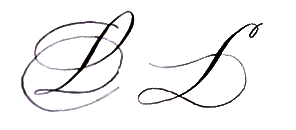
The single most prevalent transcription error in genealogy involves three letters that look remarkably similar in period handwriting: L, D, and S.
Why This Confusion Happens
In cursive writing from the 1800s through early 1900s, capital letters L, D, and S were all formed with a similar looping motion at the top. The distinguishing features are subtle:
- Capital L: Single loop ascending above the baseline
- Capital D: Loop that connects back to form the letter's stem
- Capital S: Elongated curve that can resemble either L or D depending on the writer's style
When ink faded, paper deteriorated, or enumerators wrote hastily, these already-similar letters became virtually indistinguishable.
Real-World Impact
Consider the surname "Davis"—one of the most common surnames in America. In historical records, you'll find it transcribed as:
| Actual Name | Common Mistranscriptions | Why It Happens |
|---|---|---|
| Davis | Lavis, Savis, Pavis | Capital D confused for L or S |
| Lewis | Dewis, Sewis, Dennis | Capital L interpreted as D or S; "ew" misread as "enn" |
| Sullivan | Lullivan, Dullivan | Capital S misread |
| Lawson | Dawson, Sawson | L/D/S interchangeability |
Search Strategy for L/D/S Names
- Try all three letters: Search "Lavis," "Davis," and "Savis" separately
- Use wildcards carefully: "*avis" should work theoretically, but many databases don't support initial-letter wildcards
- Browse the actual images: Once you find neighbors or relatives, manually examine the surrounding pages
- Check Soundex alternatives: L, D, and S have different Soundex codes, so phonetic searches won't catch these variations
The Double-R Problem: Marry vs Mary
The second most common transcription pattern involves double letters being read as single letters—or vice versa. This error is particularly prevalent with the letter r in cursive writing.
Why does "Harrison" sometimes appear as "Harison" in census records?
The double-r in cursive often looks like a single 'r' followed by what could be another 'r' or a 'y'. Transcribers frequently interpret "rr" as a single 'r' when the letters connect smoothly.
| Original Name | Frequent Mistranscription |
|---|---|
| Marry | Mary |
| Harrison | Harison, Haryson |
| Garrett | Garet, Garyet |
| Warren | Waren |
Capital Letter Confusion: C/G, T/F, I/J
Capital letters in cursive handwriting present unique challenges because they often incorporate decorative flourishes.
Common Pairs
- C and G: Cooper ↔ Gooper, Carter ↔ Garter
- T and F: Thomas ↔ Fhomas, Fisher ↔ Tisher
- I and J: Johnson ↔ Iohnson, James ↔ Iames
Vowel Variations: a/o/u in Cursive
Lowercase vowels—particularly a, o, and u—frequently cause transcription errors because they're all formed with similar circular motions.
| Original Name | Vowel Variations |
|---|---|
| Anderson | Andersen, Inderson, Underson |
| Martin | Morton, Marten, Murtin |
| Sullivan | Sollivan, Sallivan |
How do I search for names when the vowels might be wrong?
Use wildcards to replace uncertain vowels. Search "M*rtin" to catch Martin, Morton, and Murtin. Focus wildcards on middle vowels where confusion is most common.
Terminal Letter Flourishes: e/y/g Endings
Final letters often received decorative flourishes, making them difficult to read accurately.
- Alice ↔ Alicy: Final 'e' with flourish read as 'y'
- Nancy ↔ Nance: Final 'y' without descender read as 'e'
- Henry ↔ Henre: Minimal 'y' descender interpreted as 'e'
Your Verification Strategy
The Six-Step Process
- Start with the exact name you expect
- Apply the six error patterns systematically
- Use wildcards strategically
- Find the neighbors and browse census images
- Examine the original handwriting
- Document what you find for future searches
Soundex Limitations
| Error Type | Will Soundex Catch It? |
|---|---|
| L/D/S confusion | No - Different codes |
| Double-r variations | Yes |
| C/G confusion | No |
| Vowel variations | Yes |
Frequently Asked Questions
Should I search for every possible variation of a name?
No—focus on likely errors first. Start with the six patterns in this guide. Only expand to exhaustive variations if targeted searches fail.
How do I know if I've found the right person when the name is spelled differently?
Verify using context: correct age, birthplace, family members, occupation, and location. If 4+ details match, examine the original image.
Do transcription errors affect other records besides census?
Yes—any handwritten record that has been transcribed is susceptible: birth certificates, marriage licenses, death records, passenger lists, and military records.
Summary
- L/D/S confusion is the most prevalent error
- Double-r variations cause "Harrison" to become "Harison"
- Capital letter pairs (C/G, T/F, I/J) are easily confused
- Vowel variations (a/o/u) appear identical when written quickly
- Terminal flourishes make e/y/g endings ambiguous
- Soundex doesn't catch the most common errors
Case Study: When Lewis Became Dennis
See these patterns in action with a real genealogical mystery. In our case study, we examine how "Lewis" became "Dennis" in published county histories, and the decades-long detective work to prove family oral tradition correct. Read the Case Study
Need Help Finding Your Ancestors?
GenConverse's Genie assistant can help you track name variations across your uploaded GEDCOM files. Try Genie to explore your family data.